A searchable word & phrase collection · Mexico, 1645
Arte de la
Lengua Mexicana
Explore Nahuatl words and phrases cited by Horacio Carochi, with English glosses from James Lockhart and Spanish glosses from Carochi.
Explore vocabulary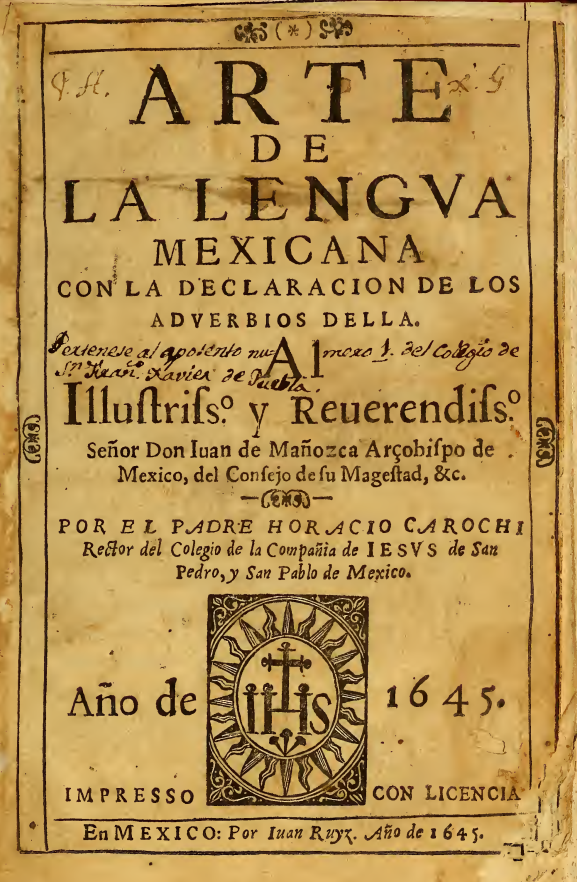
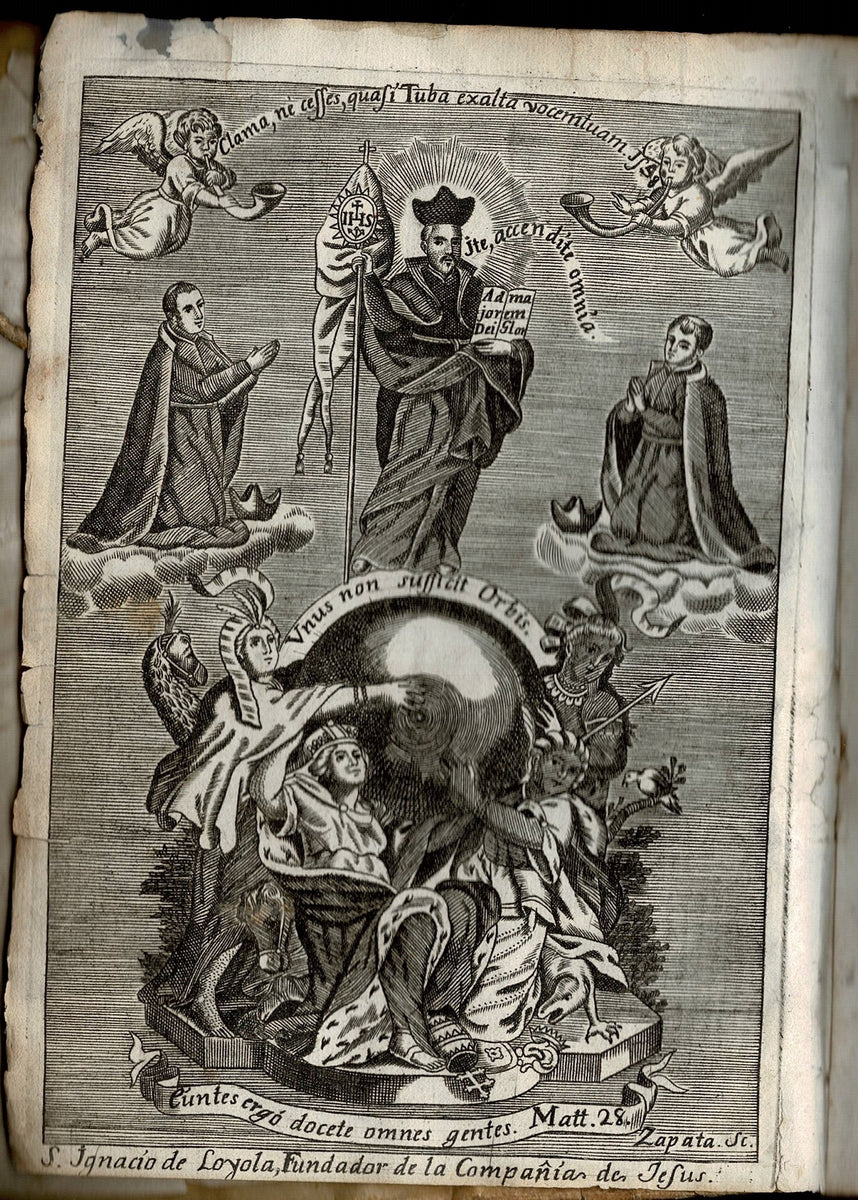 Historical Jesuit engraving
The work & its historical setting
A window into the language of seventeenth-century Mexico
Published in Mexico in 1645, Carochi's Arte de la Lengua Mexicana is an important source for the study of Classical Nahuatl. Its detailed attention to pronunciation and grammatical distinctions makes it especially valuable to students and researchers.
This site presents a searchable vocabulary extracted from Carochi’s grammar, not the complete grammar text. The entries and glosses are taken from James Lockhart’s bilingual edition (2001).
The engraving shown here provides historical Jesuit context; it is not identified as a portrait of Carochi.
Words & phrases from the Arte
Carochi’s Vocabulary
Browse the full word and phrase list or search Nahuatl, English, and Spanish. Each Nahuatl entry shows a regularized spelling followed by Carochi’s transcribed spelling in parentheses.
Carochi's Vocabulary
Interactive word & phrase list · 1645
| Nahuatl | English (Lockhart) | Español (Carochi) |
|---|---|---|
| Loading entries… | ||
About this vocabulary
This searchable word and phrase list gathers Nahuatl cited in the body of Horacio Carochi’s Arte de la lengua mexicana (1645), using James Lockhart’s bilingual edition, Grammar of the Mexican Language (2001). It is not the complete grammar. The English column gives Lockhart’s glosses and the Spanish column gives Carochi’s. Repeated citations are listed separately; Nahuatl appearing only in Lockhart’s footnotes is excluded.
Two spellings for each entry
The first spelling is regularized according to Lockhart’s English pages: macrons mark long vowels (ā, ē, ī, ō), short vowels are unmarked, and h represents the glottal stop. It also follows Lockhart’s word division. The spelling in parentheses preserves the diacritics in the transcription of Carochi’s Spanish text: macrons for long vowels, grave and circumflex accents for glottal stops, and breves for short vowels (substituting for Carochi’s acute marks). Because Carochi marked vowel length inconsistently, the spellings often differ.
Ordering, glosses, and page numbers
The source glossary is alphabetized by inferred stems, with prefixes disregarded where identifiable; phrases are filed under their first word, and ç sorts with c. The small grey number gives the page of the Spanish text in Lockhart’s edition. Explanatory notes in grey italic brackets identify forms cited without a separate translation, including paradigms, variants, particles, and forms mentioned in running text. Such notes are editorial, not Carochi’s or Lockhart’s words. Other square-bracketed English glosses may have been supplied by Lockhart.
Reliability and editorial cautions
The glossary was produced by OCR and automatic alignment of scanned Spanish and English pages, with uncertain regularized Nahuatl readings checked against page images. The parenthesized spellings were reconstructed programmatically and checked only by sample; the compiler reports that approximately one in twelve sampled parenthesized forms contained a diacritic error, most commonly a missing breve. Glosses extracted from prose may be truncated, overextended, or associated with neighboring forms. Stems were identified automatically, so some entries may be misfiled. Consult the cited edition before quoting an entry.
The website data has also been extracted from the supplied revised PDF. Its table layout may introduce additional transcription or alignment errors during conversion.