A searchable word-form collection · The Bancroft Dialogues
The Art of
Nahuatl Speech
Explore the Nahuatl word forms attested in the Bancroft Dialogues, with regularized and original marked spellings, English contextual glosses, and page references to two scholarly editions.
Explore vocabulary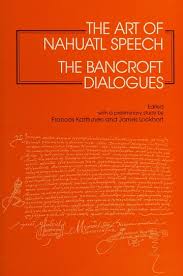
 How to Be Grateful · 2025
The work & its editions
Words of courtesy, counsel, and Nahuatl expression
The Bancroft Dialogues preserve Nahuatl speeches and exchanges that illuminate forms of address, gratitude, counsel, and social relationships. This website is a searchable index of word forms from the Nahuatl text, not a reproduction or translation of the complete dialogues.
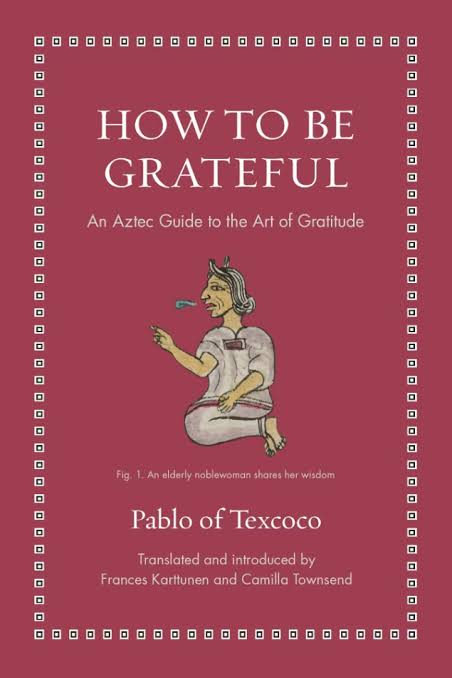
The word list draws on Frances Karttunen and James Lockhart’s The Art of Nahuatl Speech: The Bancroft Dialogues (1987), abbreviated ANS, and How to Be Grateful: An Aztec Guide to the Art of Gratitude (2025), abbreviated HTBG.
The two cover images represent the editions used for the word list. The original manuscript and the editorial histories of the editions should be consulted for fuller context.
Word forms from the Bancroft Dialogues
Bancroft Dialogues Vocabulary
Browse the entire list or search Nahuatl forms and English glosses. Each entry shows a regularized spelling followed by the original marked form in parentheses, with page references to both editions.
Bancroft Dialogues Vocabulary
Interactive word-form list · 2,116 distinct forms
| Nahuatl | English gloss | ANS pages | HTBG pages |
|---|---|---|---|
| Loading entries… | |||
About this word list
The source PDF indexes 2,116 distinct forms from 5,857 running words of Nahuatl in the Bancroft Dialogues. Entries are inflected forms as they appear in the text, not dictionary headwords. Differences in the manuscript’s vowel and glottal markings may create separate rows. Spanish headings, Spanish passages on folios 3v–4r, editors’ notes, and the editions’ analytical chapters are excluded.
Spelling and alphabetization
Each entry begins with a regularized spelling. Macrons (ā, ē, ī, ō) preserve marked long vowels; short-vowel breves are omitted in this first form; and the manuscript’s grave and phrase-final circumflex marks for glottal stops are represented by h after the vowel. The original marked form appears in parentheses, following ANS when the editions differ. Other spellings, including ç, qu, hu, tz, and editorial brackets, remain as transcribed. Sentence-initial capitals are lowered, while names retain capitals.
Entries are alphabetized by regularized spelling, ignoring macrons and brackets; ç sorts with c. This is not stem-based alphabetization. Forms with different original marks remain distinct.
English glosses and page references
Neither scholarly edition provides word-by-word glosses. The English descriptions in this list were prepared from their running translations, chiefly the literal and idiomatic ANS translations, and describe the form in its first context. (rev.) indicates a reverential form, (dim.) a diminutive, and (pl.) a plural addressee or subject. These glosses are reading aids, not quotations of the editors’ own glosses.
The last two columns list printed pages in ANS (Nahuatl transcription, pp. 106–168) and HTBG (Nahuatl text, pp. 2–128). The Nahuatl text appears on even-numbered pages. A range such as 106–112 therefore refers to 106, 108, 110, and 112.
Editorial comparison and reliability
HTBG was read from its digital text layer. ANS diacritics were recovered from printed letter shapes and compared word by word; approximately 570 differing or uncertain readings were checked visually. Not every mechanically matching word was reread, so occasional undetected differences may remain. The source PDF also includes a comparison of the two editions after the word list, describing differences in marks, letters, and small words. That comparison is not included as dictionary entries here.
Website rows were extracted from pages 2–72 of the supplied PDF; pages 1 and 73–78 were used for explanatory context only. Please verify uncertain readings and page references against the PDF and published editions before citing them.